Silk Road & Tibetan edge
Gansu Tours
Bingling grottoes, Labrang Monastery, Zhangye’s rainbow mountains and the desert gates of the Great Wall.
Gansu is China compressed into one province: glacier-fed rivers, desert, Tibetan monasteries, rainbow-coloured rock and the last great fortress of the Ming empire. It is also where the Silk Road entered China — and where most travellers still enter the idea of the Silk Road.
The shape of the land
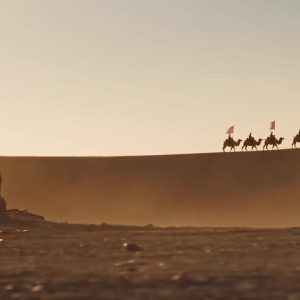
Gansu is a corridor, not a region. For 1,600 kilometres the province threads between the Qilian Mountains to the south and the Gobi to the north, a narrow band of oases that carried silk, horses, paper, Buddhism and armies in both directions for two thousand years. To the south the land rises onto the Tibetan plateau; to the west it dissolves into dunes outside Dunhuang.
That geography explains almost everything about Gansu: why its cities sit in a line, why its food is lamb and wheat, why its monasteries are Tibetan and its mosques are Chinese, and why a road trip here feels less like sightseeing and more like travelling a route that has always mattered.
History: the corridor that held an empire
In 121 BC the Han emperor Wudi sent an envoy named Zhang Qian west, and came back with reports of cities in Ferghana and Bactria. The result was the Hexi Corridor: four commanderies — Wuwei, Zhangye, Jiuquan and Dunhuang — planted along the oasis line to hold the route open. The Great Wall was extended to Jiayuguan to guard its western gate, and for the next fifteen centuries caravans paid tolls, monks carried sutras, and empires fought over water.
The cave temples are the most tangible inheritance. At Bingling Temple, a 27-metre Buddha has sat inside a Yellow River cliff since the Tang dynasty; at Mogao, outside Dunhuang, 735 caves hold 45,000 square metres of murals painted across a thousand years. Both were funded by the same trade that made the corridor worth defending.
People and belief
Gansu is one of China’s most ethnically layered provinces. Hui Muslim towns run south from Lanzhou, their mosques crowned with Chinese eaves rather than minarets. Tibetan herders move their yaks across the grasslands of Gannan. The Yugur, a Turkic-speaking Buddhist minority of barely 15,000 people, still sing their epic songs in Sunan. And in Lanzhou, the whole province eats the same breakfast: beef noodles pulled to order, chilli oil, radish, a fistful of coriander.
Travel here is not a museum visit. Monasteries are working institutions; butter lamps are lit for exams and harvests; the monk who shows you Labrang’s chapels in the morning may be the same man repairing the roof in the afternoon.
When to go
May, June, September and October are the sweet spot: warm days, cool nights, clear light for the Danxia landforms and the desert. July and August are greenest on the grasslands and busiest around Qinghai Lake and Labrang. Winter is cold but the caves and the desert are empty, and Dunhuang in snow is worth the coat.
You do not come to Gansu for comfort. You come because the road still feels like a road, and because every valley has someone who has lived there for forty generations.
What we do here
- Private 5–9 day routes linking Lanzhou, Xiahe, Zhangye, Jiayuguan and Dunhuang
- Monastery mornings with monk guides rather than audio headsets
- Mogao Caves with a specialist, booked months ahead for the best cave slots
- Family-friendly versions with shorter drives and hotel pools
Region film
Gansu Tours in motion
Book online
Gansu Tours — fixed departures
Prices are per person, twin share. Solo, family and private-date departures available — just ask on WhatsApp.
Want this route, but different?
Change the days, the hotels, the pace — or bolt two regions together. Send us the outline and we will price it within 12 hours.
Keep exploring
Other regions
Qinghai Tours
Qinghai Lake, the mirror of Chaka, Tibetan monasteries and the empty Qaidam Basin.
ExploreGansu-Qinghai Grand Loop
Seven to ten days linking Xining, Qinghai Lake, Dunhuang, Jiayuguan and Zhangye in one unbroken line.
ExploreGannan & Longnan
Tibetan Labrang, the stone-box village of Zhagana, and Longnan’s green tea mountains.
ExploreHexi Corridor
Wuwei, Zhangye, Jiayuguan and Dunhuang — a thousand kilometres of frontier history.
ExploreHainan Tours
Yalong Bay resorts, rainforest trails and Li minority villages, best from November to April.
Explore4WD Overland Expeditions
Unpaved tracks, high passes, wild camping and nomad homestays — for travellers who want the road itself.
Explore