The Silk Road’s spine
Hexi Corridor
Wuwei, Zhangye, Jiayuguan and Dunhuang — a thousand kilometres of frontier history.
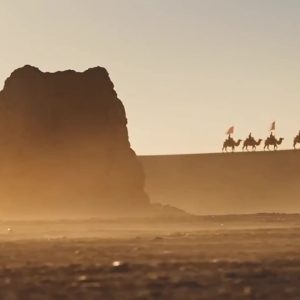
The Hexi Corridor is the spine of the Silk Road in China: a thousand kilometres of oasis cities strung between mountains and desert, each one guarding a piece of the route west. Wuwei, Zhangye, Jiuquan, Jiayuguan, Dunhuang.
Why a corridor
South of the corridor rise the Qilian Mountains, feeding glaciers that melt into the rivers that make the oases possible. North is the Gobi and the Mongolian border. Between them runs a strip of fertile ground never more than a hundred kilometres wide — the only practical road from China into Central Asia. Whoever held it controlled trade, and every dynasty knew it.
Four cities, four layers of history
Wuwei is where a Han general’s bronze horse — the Flying Horse of Gansu — was excavated from a tomb in 1969; the Tiantishan grottoes nearby hold early Buddhist painting. Zhangye has the reclining Buddha, 35 metres long, and the Mati Temple caves cut into a cliff; an hour outside the city the Danxia landforms stripe the hills red, orange and grey. Jiayuguan is the western gate of the Ming Great Wall: a fortress so complete it looks staged, with the Overhanging Wall climbing a black ridge behind it. Dunhuang is the end point — and the reason most people come.
The caves at Dunhuang
Mogao is one of the great art sites of the world: 735 caves, 45,000 square metres of murals, 2,000 painted sculptures, painted over ten centuries by donors, monks and travelling workshops. It survives because of the desert, and because of the Dunhuang Academy’s conservation work — only a fraction of the caves are open, on timed entry, with a guide. We book the earliest slot, add a specialist for the deep caves, and follow with the Singing Sand Dunes at sunset.
How to travel it
By road, west to east or east to west, 5 to 7 days. High-speed rail now links Lanzhou, Zhangye, Jiayuguan and Dunhuang, and we use it for the long hops when travellers prefer trains to cars. Either way, the corridor rewards slow travel: the pleasure is in the gaps between cities, not the cities themselves.
When to go
April to October. September and October are ideal: warm, dry, clear, and the grape harvest in the Wuwei and Jiayuguan vineyards. July and August are hot at midday but the evenings are superb. Winter is cold and very quiet, with the caves almost to yourself.
Every oasis on this road was an argument with the desert, won by a river. Some of them are still winning.
Region film
Hexi Corridor in motion
Book online
Hexi Corridor — fixed departures
Prices are per person, twin share. Solo, family and private-date departures available — just ask on WhatsApp.
Want this route, but different?
Change the days, the hotels, the pace — or bolt two regions together. Send us the outline and we will price it within 12 hours.
Keep exploring
Other regions
Gansu Tours
Bingling grottoes, Labrang Monastery, Zhangye’s rainbow mountains and the desert gates of the Great Wall.
ExploreQinghai Tours
Qinghai Lake, the mirror of Chaka, Tibetan monasteries and the empty Qaidam Basin.
ExploreGansu-Qinghai Grand Loop
Seven to ten days linking Xining, Qinghai Lake, Dunhuang, Jiayuguan and Zhangye in one unbroken line.
ExploreGannan & Longnan
Tibetan Labrang, the stone-box village of Zhagana, and Longnan’s green tea mountains.
ExploreHainan Tours
Yalong Bay resorts, rainforest trails and Li minority villages, best from November to April.
Explore4WD Overland Expeditions
Unpaved tracks, high passes, wild camping and nomad homestays — for travellers who want the road itself.
Explore